Jacquemus, CGI Campaigns and the Manipulation of Photographic Truth
When advertising looks like reality
Question 4:What is the role of photography in digital screen culture today in relation to spectacle, simulation and manipulation of images? Find one example (a single image, a series of photos, or a campaign) to illustrate and discuss.
Explore the captivating world where digital art blurs the lines of perception. This microsite delves into Jacquemus’s revolutionary "Le Bambino Bags on Wheels" CGI campaign, examining how contemporary digital photography transforms our understanding of spectacle, simulation, and image manipulation.
CGI of Jacquemus
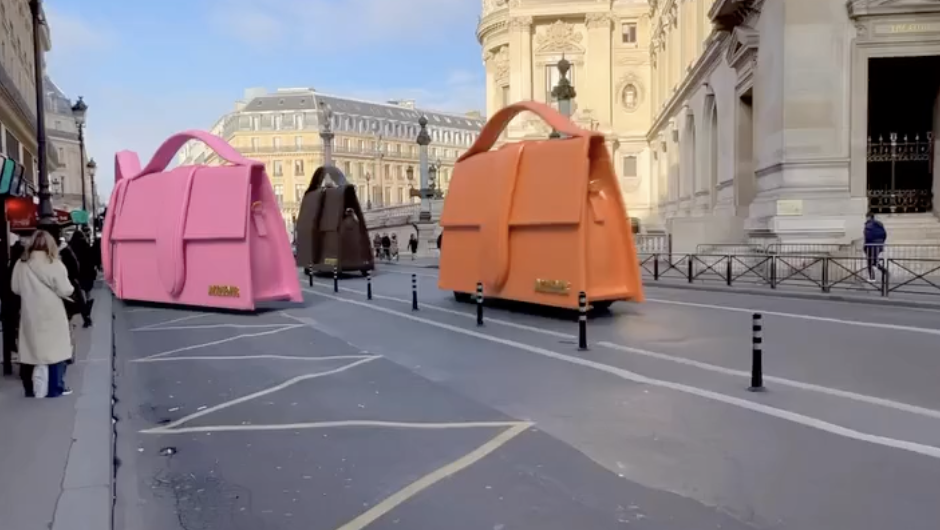
The original video shows giant Le Bambino bags moving through the streets of Paris like public transport. It was posted on Instagram on 5 April 2023 and later circulated widely across platforms such as TikTok. At the time of access, the post had 48.8 million views and over 2 million likes on Instagram. Google Trends also showed a spike in searches for “Jacquemus bag” between 2 April and 8 April 2023.

The power of CGI
The power of CGI lies in its ability to make impossible events appear visually believable. In this project, CGI is used to explore how digital advertising can create scenes that look like documentary street footage, even when they never happened in physical space. The website will analyse how CGI changes the role of photography in digital screen culture: photography no longer only records reality, but becomes a visual language that can support spectacle, simulation and image manipulation.
Spectacle
The campaign turns the handbag into a visual event. By enlarging the product to the scale of public transport, Jacquemus transforms Paris into a branded stage designed for attention, sharing and digital circulation.
Simulation
The video does not record a real event. Instead, it simulates the experience of witnessing something strange but believable in the city, making a digitally generated scene feel temporarily real.
Manipulation
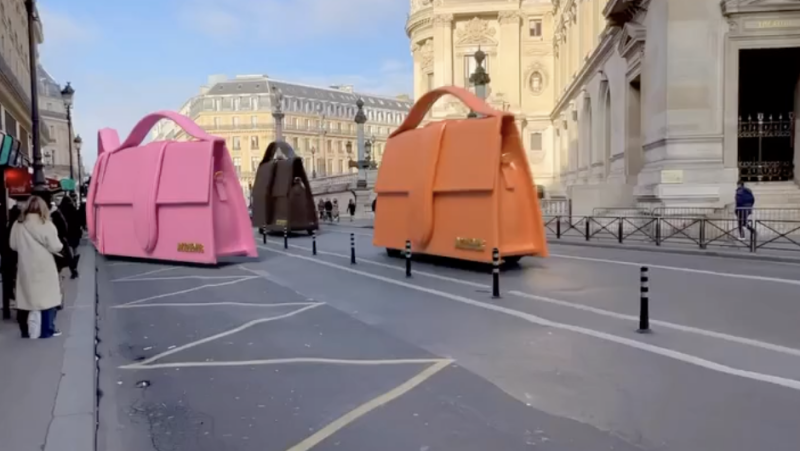
The campaign is constructed through CGI. The Paris street, oversized handbags, shadows, movement and perspective are digitally combined, showing how image manipulation becomes a visual strategy rather than just post-production editing.
Spectacle: The Handbag as a Visual Event
Introduction to the study
Using Guy Debord’s concept of spectacle, the Jacquemus campaign can be understood as more than a product advertisement. In The Society of the Spectacle, Debord argues that modern social life is increasingly mediated through images. This is useful for understanding the campaign because the handbag is not presented simply as an object to buy. Instead, it becomes a visual event designed to attract attention, produce discussion and circulate across digital platforms.
The scale of the handbag is central to this transformation. A Le Bambino bag is normally a small, wearable fashion accessory, but in the campaign it becomes the size of a bus. This exaggerated scale turns the product into something impossible, playful and memorable. The object no longer belongs to the body or the shop display; it enters the city as a spectacular image. Paris becomes a branded stage, while the street becomes part of the advertisement.
Their power comes from how they appear on screens and how they circulate through platforms such as Instagram and TikTok. Viewers pause, replay, question and share the video because it looks both real and impossible. In this sense, the spectacle is not only created by the giant handbag itself, but also by the digital circulation around it.
The campaign shows how photography in digital screen culture can function as a container for spectacle. The video borrows the look of casual street footage, which makes the CGI event feel grounded in everyday reality. Because it looks like something filmed on a phone, the impossible image becomes temporarily believable. The result is a branded visual event that turns uncertainty into engagement: viewers ask, “Is this real?” and that question becomes part of the campaign’s success.

Simulation and Manipulation
Baudrillard’s concept of simulation helps explain why this image is more than a simple fake. The campaign does not only imitate reality; it produces the feeling of a real event. The viewer seems to witness a strange but believable moment in the city, even though the giant handbags never physically occupied the streets of Paris.
The image borrows the visual language of mobile documentation: short duration, vertical format, urban movement and a seemingly spontaneous street perspective. These details make the campaign feel like casual phone footage rather than a traditional fashion advertisement.
At the same time, the campaign depends on image manipulation. The Parisian street functions as a realistic visual environment, while the oversized handbags are inserted as digital objects. Scale, shadow, movement, perspective and compositing all work together to make the impossible scene appear believable.
In this sense, manipulation is not simply post-production retouching. The event itself is digitally constructed. Photography becomes a reality-effect: a visual language that gives credibility to synthetic images.
Critical Discussion and Conclusion
The campaign raises questions about trust in digital screen culture. If an advertisement can look like documentary street footage while showing something that never physically happened, then the boundary between visual evidence and visual fiction becomes unstable. The campaign turns uncertainty into engagement: the question “Is this real?” becomes part of the marketing strategy.
The Jacquemus campaign shows that photography in digital screen culture no longer functions simply as a record of reality. It becomes a visual language that can support spectacle, simulation and manipulation. The photographic look remains powerful, but that power can now be borrowed by CGI to make impossible events appear real, shareable and commercially valuable.
Email:zl1m25@soton.ac.uk Student number:35795719